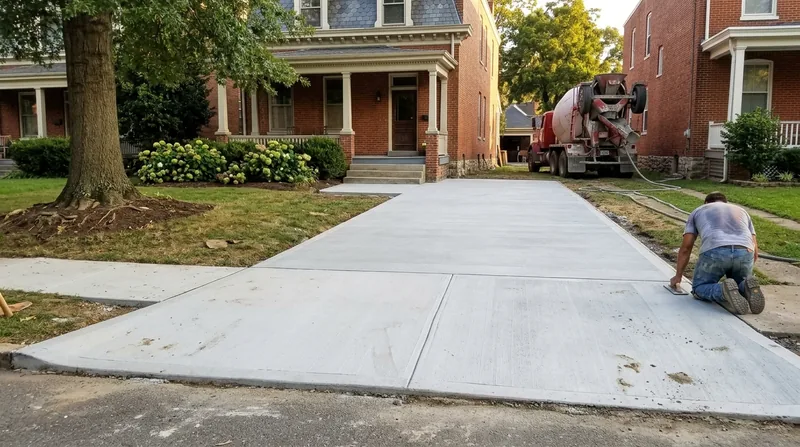




Concrete driveways in Richmond face a unique set of challenges. Richmond's Piedmont clay and freeze-thaw cycles, combined with the weight of modern vehicles and the root pressure from mature oak and maple trees, demand a driveway built to last. Whether you live in the brick rowhouses of Church Hill, the postwar ranches of Henrico, or the newer colonials spreading through Short Pump and Glen Allen, your driveway needs proper sub-base preparation, high-strength concrete mix, and correctly spaced control joints to handle decades of traffic and weather. A poorly installed driveway will crack, settle, and heave within five to ten years. The right contractor builds one that stays flat and solid for 30 years or more.
Why Concrete Driveways Matter in Richmond's Climate and Soil
Richmond's weather pattern is hard on asphalt and weak concrete. Winter brings repeated freeze-thaw cycles that push water into micro-cracks, expanding and splitting the surface. Summer heat and humidity accelerate oxidation. Spring and fall tropical-storm remnants dump heavy rain that tests drainage and sub-base stability. The red Piedmont clay and sandy Coastal Plain soils beneath your driveway shrink and swell with moisture, lifting and settling slabs by fractions of an inch each year. Over time, that movement cracks unsealed concrete and creates trip hazards.
- Freeze-thaw cycles in winter split thin or poorly-finished concrete within the first two to three years.
- De-icing salt used on Richmond streets scales the surface of unsealed driveways, roughening and weakening them.
- Root pressure from mature trees lifts and cracks driveways that sit too close to oaks, maples, and willows.
- Poor sub-base or inadequate slope allows standing water to weaken the slab from below, causing settlement and cracking.
- Thin concrete or improper joint spacing allows stress to concentrate in the wrong places, leading to premature failure.
A properly installed concrete driveway handles all of these stressors because it starts with the right foundation and materials.
Richmond reality: Homeowners in Windsor Farms, Ginter Park, and Forest Hill often have mature trees near their driveways. We set our slabs at least 10 feet from tree trunks and slope the surface away from the tree line to keep roots from lifting the concrete. In Midlothian and Chester, where wooded lake communities sit on clay and sand mixes, we account for seasonal shrink-swell by using thicker slabs and reinforced sub-base.
For permit requirements and right-of-way guidelines specific to your neighborhood, check the City of Richmond Department of Public Works.
How We Build a Driveway That Lasts in Richmond
Every concrete driveway we install follows a proven sequence: site assessment and excavation, sub-base preparation, formwork, concrete mix design, pouring and finishing, and proper curing. We do not rush any step. A driveway poured in cold weather or without adequate curing time will fail, no matter how good the concrete is. We also choose finishes that match your home's style and provide safe traction in wet conditions.
- We excavate to the correct depth and remove soft or unstable soil, then compact a 4 to 6 inch gravel sub-base to ensure proper drainage and load distribution.
- We set and level wooden or aluminum forms to the finished height and slope, typically a 1/8 inch per foot drop toward the street for drainage.
- We mix high-strength concrete (4,000 PSI minimum) and pour it into the formed area, vibrating to remove air pockets and ensure full consolidation.
- We finish the surface with a broom, trowel, stamped pattern, or exposed aggregate to match your home and provide slip resistance.
- We cut control joints every 4 to 6 feet to direct cracking into those planned lines instead of random cracks across the slab.
- We protect the curing concrete for 7 days, keeping it moist and preventing traffic, so the cement hydrates fully and gains strength.
This process takes 10 to 14 days from start to finish, depending on weather and driveway size. During hot summers, we work early morning or late afternoon to avoid rapid evaporation. During cold months, we use concrete accelerators and insulating blankets to maintain proper curing temperature.
Example from Tuckahoe: A 600-square-foot driveway replacement for a Colonial Revival home took 12 days. We excavated the failed asphalt and soft sub-base, poured 5 inches of 4,000 PSI concrete with a broom finish for traction, and cut control joints every 5 feet. After 7 days of curing, the homeowner had a flat, solid surface rated for 30+ years of use.
Learn more about our approach to concrete repair and resurfacing when existing driveways need restoration instead of replacement.
Concrete Driveway Finishes and Methods
| Finish Type | Description | Best for |
|---|---|---|
| Broom Finish | A stiff broom dragged across fresh concrete creates a textured surface that resists slipping in rain and ice. | Most residential driveways in Richmond, especially homes with steep slopes or shaded areas prone to ice. |
| Exposed Aggregate | The top layer of cement is washed away to reveal smooth pebbles or gravel, creating a decorative and slip-resistant surface. | Homes in Windsor Farms, Ginter Park, or other neighborhoods where curb appeal and durability matter equally. |
| Stamped Concrete | Patterns pressed into fresh concrete mimic brick, stone, or tile, then sealed for color and protection. | Newer homes in Short Pump, Glen Allen, or Chester where stamped patios and pool decks complement the driveway. |
| Smooth Trowel Finish | A flat, smooth surface created by hand or power trowel, often sealed for a polished look and easier snow removal. | Commercial or contemporary residential driveways where a clean, modern aesthetic is the priority. |
All finishes benefit from concrete sealing every 2 to 3 years to protect against Richmond's freeze-thaw cycles and de-icing salt.
Concrete Driveways Cost in Richmond: What to Expect
Concrete driveway pricing in Richmond typically starts at $6 per square foot for a basic broom-finish installation on stable, well-prepared ground. A 500-square-foot driveway at that rate costs around $3,000. A 1,000-square-foot driveway runs $6,000 or more. However, several factors push the final cost up or down. Removing a failed asphalt or concrete driveway adds $1 to $2 per square foot. Excavation through clay or shifting soil adds time and labor. Proximity to mature trees or structures may require hand-digging and careful sub-base work. Exposed aggregate or stamped finishes cost 20 to 40 percent more than broom finish. Sloped or multi-level driveways require more formwork and finishing skill.
The best way to understand cost for your specific driveway is to request a free estimate. We assess the site, measure the area, evaluate soil and drainage, and account for any tree or structural concerns. Two or three estimates from different contractors give you a realistic range and help you spot low-ball quotes that cut corners on sub-base or concrete strength.
Visit our full pricing overview for detailed breakdowns and examples from similar jobs in your area. Call us at (804) 885-2499 for a free, no-obligation estimate within 24 hours.
Concrete Driveways Near Me: What Richmond Homeowners Should Know When Hiring
Choosing the right concrete contractor is as important as the concrete itself. A skilled crew builds a driveway that lasts; an inexperienced one cuts corners on sub-base, uses weak concrete, or skips proper curing, leaving you with cracks and settlement within three to five years. Before you hire, verify that the contractor carries general liability insurance and workers compensation coverage for all crew members. Request a certificate of insurance and do not hesitate to call the insurance company to confirm coverage is active. Ask for references from recent jobs in Richmond, Glen Allen, Midlothian, or Chester, and call at least two to ask about the quality of work and how the contractor handled any issues.
Understand permit requirements for your location. Some Richmond neighborhoods, especially historic districts like the Fan or Church Hill, may require approval before work begins. If your driveway sits near a curb cut or right-of-way, the city may have width or setback rules. Homeowner associations in communities like Short Pump or Brandermill often require notice or approval before exterior work. A good contractor knows these rules and helps you navigate them, or at least explains what permits you need to pull yourself.
Get everything in writing: scope of work, materials (concrete strength, sub-base depth, finish type), timeline, total price, and warranty. A detailed contract protects both you and the contractor and prevents misunderstandings about what is included.
Ready to move forward? Contact Richmond Concrete for a free estimate and to discuss your driveway project with a field professional who knows Richmond's soil, climate, and building stock inside and out.
Concrete Driveways in Richmond: Pricing Guide
| Service | Price | Details |
|---|---|---|
| Basic Concrete Driveway | Starting at $6/sq ft | Broom finish, 4,000 PSI concrete, proper sub-base, control joints, includes excavation and removal of old surface |
| Exposed Aggregate or Stamped Finish | Starting at $8-10/sq ft | Decorative surface treatment adds 30-40% to base price; seal included to protect pattern and color in Richmond's freeze-thaw cycles |
| Complex Site or Tree Proximity | On estimate | Hand-digging near roots, reinforced sub-base for clay shrink-swell, slope adjustments, or multi-level work require site assessment before pricing |
| Driveway Removal and Replacement | Starting at $7-9/sq ft | Demolition of failed asphalt or concrete, haul-away, excavation, new sub-base, and new pour; total cost depends on debris volume and soil condition |
| Travel and Estimate | Free and included | No mileage fee within Richmond and surrounding areas; free estimate within 24 hours at (804) 885-2499, no obligation to book |
Indicative pricing, the exact cost depends on square footage, finish, and site access. Free personalized estimate within 24h at (804) 885-2499.


